
GUANGDONG XIEDA INTELLIGENT EQUIPMENT CO., LTD.
Professional manufacturer of storage space

News
News
Optimize warehouse management: Improve shelf utilization rate
Keywords:
Publish Time:
2025-07-19
Here are some methods to optimize warehouse management and improve shelf utilization:
I. Reasonable shelf layout planning
1. Classification according to cargo characteristics
- Classify goods according to their size, weight, shape, turnover rate, etc. For example, goods with large volume, heavy weight and slow turnover can be placed in the outer shelves on the lower floors of the warehouse, which is convenient for handling by forklifts and other equipment, and avoids excessive pressure on the upper shelves; while goods with small volume, light weight and fast turnover can be placed on the middle or upper shelves to improve space utilization.
- Layout according to the relevance and complementarity of goods. For example, place items that are often sold or used together on adjacent shelves, which can reduce the walking distance of employees during replenishment and picking, and improve work efficiency.
2. Use appropriate shelf types
- For small items with high turnover rates, flow-through shelves can be used. This type of shelf uses gravity to automatically slide goods to the picking end, which can achieve first-in, first-out, and can store a large amount of goods in a limited space, improving the vertical space utilization rate of the shelves.
- For long and bar-shaped goods, such as steel and pipes, cantilever shelves can be used. Cantilever shelves can be customized according to the length of the goods, making full use of the height and width of the warehouse, and reducing space waste.
- For large quantities of goods with few varieties, such as whole boxes of beverages and food, pallet shelves can be used. This type of shelf is easy for forklifts to handle, can make full use of warehouse space, and can increase storage capacity by stacking pallets.
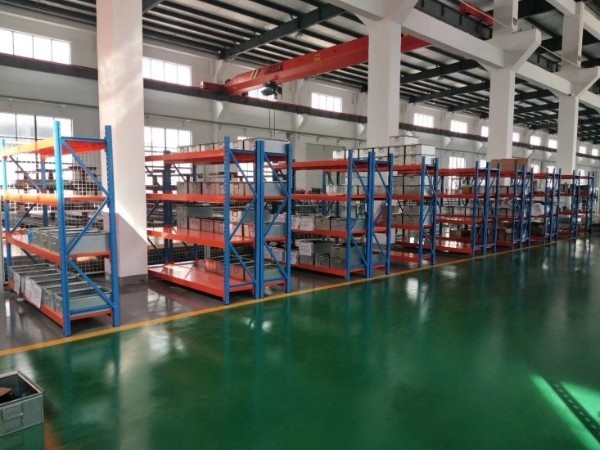
3. Consider aisle design
- Reasonably set the width of the aisles between shelves. The aisle width should be determined according to the size and operating requirements of the handling equipment. If the aisle is too wide, it will waste valuable warehouse space; if the aisle is too narrow, it will affect handling efficiency and safety. Generally speaking, the forklift aisle width should be around 3-4 meters, considering the turning radius of the forklift and the size of the goods. At the same time, for manual picking aisles, the width can be appropriately reduced, but it must ensure that employees can pass and operate comfortably.
- Adopt a two-way aisle or ring aisle design. This can improve the operating efficiency of forklifts and reduce the travel time of forklifts in the warehouse. For example, in a rectangular warehouse, the shelves can be arranged in the form of a two-way aisle in the middle, and forklifts can enter the aisle from both ends to handle goods, avoiding complex operations such as turning around in the warehouse, and improving the overall operation efficiency of the warehouse.
II. Precise inventory management
1. Inventory checking and monitoring
- Regularly conduct inventory checks to ensure the accuracy of inventory data. Advanced inventory management systems can be used, combined with barcode and RFID technologies, to track the entry and exit of goods in real time. For example, through RFID tags, goods information can be quickly read without opening the packaging, improving inventory efficiency. Accurate inventory data helps to reasonably arrange the storage location of goods, avoid backlog or shortage of goods, and thus improve shelf utilization.
- Set up an inventory warning mechanism. According to the sales speed, procurement cycle and other factors of the goods, set safety stock and replenishment points for each type of goods. When the inventory is below the replenishment point, replenish in time to avoid idle shelf space due to out of stock. At the same time, when the inventory is close to the upper limit of the safety stock, control the purchase quantity to prevent backlog of goods.
2. ABC classification management
- Classify goods into A, B, and C categories according to their importance and value. A-class goods are key goods with high value and fast turnover, and should be placed in a location close to the picking area and easy to access, such as the front row of the middle shelves; B-class goods are goods with moderate value and turnover rate, which can be placed in the back row of the middle shelves or the front end of the upper shelves; C-class goods are goods with low value and slow turnover, which can be placed in the corners of the warehouse or the back end of the upper shelves. Through this classification management, the storage and picking efficiency of A-class goods can be prioritized, while other goods can be reasonably stored using shelf space.
III. Optimize cargo storage methods
1. Use appropriate packaging and unit loading
- Reasonably package goods to standardize their size. For example, package small items into uniform sizes, which is convenient for neat arrangement on shelves and reduces space waste. At the same time, adopt unit loading methods, such as placing goods in pallets, turnover boxes or containers. The size and specifications of the pallets should match the shelf size and handling equipment, so that forklifts can be easily handled, and multiple pallets can be stacked on the shelves to improve storage height and space utilization.
- For some irregularly shaped goods, customized packaging or containers can be used to allow them to be tightly placed on the shelves. For example, for complex-shaped goods such as auto parts, special pallets or shelf compartments can be designed to classify and place parts in them, making full use of shelf space.
2. Adjust the storage order of goods
- Dynamically adjust the storage order of goods on the shelves according to the frequency of entry and exit and shelf life of goods. Place goods that are frequently entered and exited in easy-to-access locations, such as the middle and front rows of shelves; for goods that are not frequently entered and exited, they can be placed in the upper or back rows. At the same time, for goods with shelf life requirements, they should be stored according to the first-in, first-out principle to avoid losses and space waste due to expired goods. For example, in food warehousing, foods with earlier production dates are placed in the front row of shelves to ensure that they are shipped first to prevent expired foods from occupying shelf space.
IV. Introduce advanced technology and equipment
1. Automated storage system
- Install an automated three-dimensional warehouse. This type of warehouse uses high-level shelves, stacker cranes and computer control systems to realize automatic storage and retrieval of goods. It can make full use of warehouse space, especially vertical space, greatly improving shelf utilization. Stacker cranes can accurately store goods in designated shelf locations and quickly retrieve them when needed, reducing the time and error rate of manual searching for goods.
- Use automated guided vehicles (AGVs). AGVs can automatically drive on the warehouse floor along preset routes to transport goods to or from shelves. It can shuttle in narrow aisles and, compared with traditional forklifts, can better adapt to complex shelf layouts and improve space utilization.
2. Warehouse management software
- Employing advanced Warehouse Management Software (WMS) to optimize shelf utilization. WMS can comprehensively manage warehouse shelves, goods, and equipment, calculating the optimal storage locations for goods through algorithms. For example, it can automatically allocate goods to the most suitable shelf locations based on factors such as size, weight, and turnover rate, and update shelf occupancy in real-time during goods entry and exit, facilitating monitoring and adjustments by management personnel. Simultaneously, WMS can integrate with the company's Supply Chain Management System (SCM) and ERP system to achieve information sharing and collaboration, further improving the efficiency and accuracy of warehouse management.
Hot Products
Related Articles
Get a free quote
We welcome any inquiry you may have. Tell us about your project to get a free quote.
National Service Hotline
Contact Email
Foshan City, Nanhai District, Shishan Town, Guanyao Ligang Zixia Industrial Zone
Scan to view the website