
GUANGDONG XIEDA INTELLIGENT EQUIPMENT CO., LTD.
Professional manufacturer of storage space

News
News
What type of shelving is suitable for use in the warehouse?
Keywords:
Publish Time:
2025-07-28
Warehouse racking selection requires consideration of factors such as cargo characteristics, storage needs, space utilization, and operational efficiency. The following are common types of racking and their applicable scenarios for reference:
-
I. Main Racking Types Classified by Structure
1️⃣ Heavy-duty Pallet Rack
✅ Features: Strong load-bearing capacity (usually ≥500kg/layer), suitable for palletized goods; the upright and beam combination allows for flexible adjustment of height and depth.
📦 Applicable Scenarios: Bulk storage of large items (such as cartons, barrels of raw materials), warehouses with frequent forklift operations.
💡 *Advantages*: Strong versatility, can be combined with multi-layer mezzanines or automated equipment upgrades.
2️⃣ Medium-duty Shelving Units
✅ Features: Layered shelf design, supports manual access to small and medium-sized items; relatively low height (generally <3 meters).
📦 Applicable Scenarios: Parts warehouses, e-commerce picking areas, storage of tools and consumables.
⚠️ *Note*: Limited single-layer load-bearing capacity (approximately 150-300kg), not suitable for overweight items.
3️⃣ Drive-in Racking
✅ Features: “Last-in, first-out” (LIFO) mode, forklifts can directly drive into the aisle to continuously store multiple pallets.
📦 Applicable Scenarios: Large quantities of a single item with low turnover (such as frozen goods in cold chain storage).
⛔️ *Disadvantages*: Cannot implement first-in, first-out (FIFO), use with caution for goods sensitive to shelf life.
4️⃣ Shuttle Racking System
✅ Features: Combines tracks and automated guided vehicles (AGVs) to achieve semi-automated high-density storage.
📦 Applicable Scenarios: High-frequency, large-volume standardized goods (common in the food and beverage industry).
🤖 *Intelligent Trend*: Can be connected to the WMS system to improve efficiency, but the initial investment is higher.
5️⃣ Gravity Flow Shelving
✅ Features: Inclined track + rollers, using gravity to automatically replenish goods to the front.
📦 Applicable Scenarios: Production line supporting material supply (such as auto assembly plant parts).
⏰ *Time Efficiency Advantage*: Ensures materials are “available on demand”, reducing storage time.
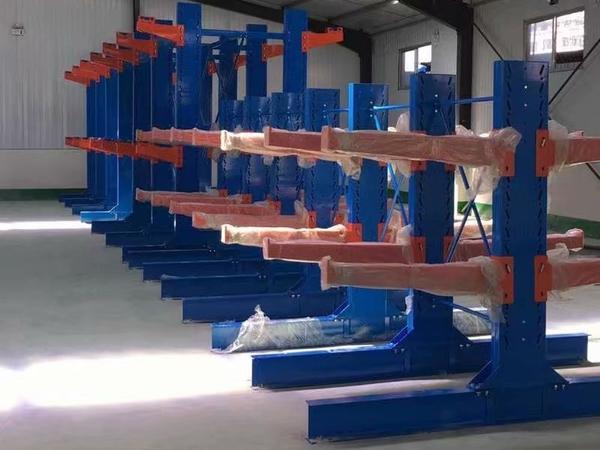
6️⃣ Cantilever Shelves
✅ Features: Unhindered long arm extension, suitable for storing irregularly shaped long materials.
📦 Typical Applications: Storage of extra-long materials such as pipes, profiles, and carpet rolls.
🔍 *Comparative Advantage*: Saves 30% more aisle space than traditional racking.
7️⃣ Mezzanine Floor System
✅ Features: Double-layer structure doubles the effective storage area, while the lower layer retains forklift access.
🏢 Applicable Scenarios: High-ceiling old factory renovations, zoning management of light small items and heavy equipment.
💰 *Cost Effectiveness*: Construction cost is approximately 1/5 to 1/3 of expanding a new warehouse.
II. Key Factors in Racking Selection
| Consideration Dimension | Specific Impact |
||-|
| ✔️Goods Size/Weight | Extra-long steel materials choose cantilever racks; precision instruments require dust-proof cabinets |
| ✔️In/Out Frequency | High-frequency turnover recommends flow-through or automated storage systems; slow-moving goods can use upper space |
| ✔️Access Method | Mechanical operations prioritize beam racks; manual picking focuses on shelf height optimization |
| ✔️Building Restrictions | Column spacing determines rack span; ground load-bearing capacity restricts top-level load |
| ✔️Budget | Start-up companies can choose second-hand steel structure racking; large logistics centers tend towards customized automated solutions |
| ✔️Scalable Expansion | Modular component design facilitates later addition or reduction of levels, avoiding repeated purchases.
-
III. Industry Case Studies
▶️ Manufacturing Raw Material Warehouse
Uses a combination of heavy-duty beam racks and cantilever racks: the main aisle stores molds (pallet load 2 tons), and the sides store steel raw materials (6 meters long per piece). RFID tags are used for batch traceability.
▶️ Pharmaceutical Cold Chain Warehouse
Uses drive-in racking with temperature control sensors: each storage location independently monitors temperature fluctuations, meeting GSP certification requirements while increasing space utilization to 85%.
▶️ E-commerce Forward Warehouse
Deploys a shuttle system linked to electronic label picking: peak order processing capacity reaches 1200 pieces/hour, with an error rate controlled below 0.03%.
-
IV. Pitfalls to Avoid
❌ Pitfall 1: Blindly pursuing high-density storage
→ Leads to complicated picking paths, thus reducing efficiency. It is recommended to balance density and accessibility through ABC classification.
❌ Pitfall 2: Ignoring dynamic load changes
→ Example: Temporary installation of shelves during seasonal surges in goods may cause structural instability. A 20% safety margin should be reserved.
❌ Pitfall 3: Ignoring ergonomics
→ Frequently used materials should be placed in the waist to eye level range (700-1500mm), which can reduce employee bending by more than 40%.
-
V. Future Trend Insights
🔹 Intelligent Integration: AI algorithms optimize storage location allocation, and the Internet of Things monitors the health status of shelves in real time (such as tilt alarms).
🔹 Green Materials: Recycled aluminum replaces traditional steel, reducing weight by 30% while maintaining the same strength.
🔹 Flexible Customization: 3D printing of non-standard connecting pieces to handle special cargo forms, shortening the delivery cycle to within 7 days.
-
Summary Recommendation Table
| Business Type | Recommended Solution | Core Benefits |
||-||
| Bulk Commodity Wholesale | Heavy-duty beam rack + forklift collaboration | Maximized single load capacity |
| Spare Parts Management | Medium-sized shelving + label zoning | Visualized quick location |
| Fresh Food Cold Chain Delivery | Flow rack + temperature and humidity monitoring | Loss rate reduced by 15%-25% |
| Cross-border Bonded Warehousing | Automated high-bay warehouse | Customs inspection efficiency increased by 60% |
The final solution should be stress-tested based on SWOT analysis, such as simulating whether fire evacuation routes are unobstructed and the stability of the shelves in extreme weather. For large warehouses with a daily throughput exceeding 500 pallets, it is recommended to introduce simulation software to verify the feasibility of the solution in advance.
Hot Products
Related Articles
Get a free quote
We welcome any inquiry you may have. Tell us about your project to get a free quote.
National Service Hotline
Contact Email
Foshan City, Nanhai District, Shishan Town, Guanyao Ligang Zixia Industrial Zone
Scan to view the website