
GUANGDONG XIEDA INTELLIGENT EQUIPMENT CO., LTD.
Professional manufacturer of storage space

News
News
Xiada Intelligent Equipment: What is a through-type rack factory?
Keywords:
Publish Time:
2025-07-29
Drive-in rack factories specialize in the design, manufacturing, and installation of drive-in racks (also known as drive-through racks or deep lane racking). Below is a detailed introduction to these factories and their products:
1. Product Definition and Structural Characteristics
- Continuous Integral Design: Unlike traditional racking systems with aisle separations, drive-in racking uses a continuous, uninterrupted arrangement. Goods are stored densely on pallets in the depth direction, forming interconnected storage units. Forklifts can directly enter the rack for storage and retrieval operations.
- High-Density Storage Advantages: By eliminating aisles between rows, space utilization is almost 2-3 times that of conventional pallet racking, making it especially suitable for storing large quantities of a few types of goods. For example, it is widely used in cold storage and other high-cost warehousing environments.
- Component Composition: Includes uprights, diagonal braces, horizontal braces, cantilever beams (special stamping), rails, and reinforcement devices (such as a reinforced net-like structure). Some configurations include foot guards and rail guards to prevent collisions.
2. Functional Characteristics
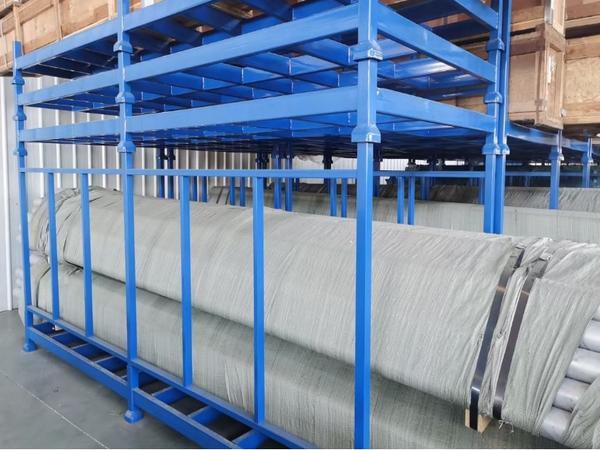
- Flexible Entry/Exit Modes: Supports both "First-In, First-Out" (FIFO) and "Last-In, First-Out" (LIFO) management methods. However, due to structural stability limitations, the height is usually controlled within 10 meters, and additional diagonal bracing and back nets are required for safety.
- Adaptability to Specific Goods Specifications: Single pallet load capacity can reach over 2 tons, but requires a pallet span not exceeding 1.5 meters and even weight distribution of goods to ensure operational safety and rack stability.
- Efficiency Improvement: Forklifts do not need to frequently turn and switch aisles, shortening the running path and significantly improving storage and retrieval speed; the fully-interlocking assembly structure facilitates quick installation and maintenance.
3. Application Areas
- Industry Coverage: Widely used in food and beverage (dairy, beer), tobacco, pharmaceutical, chemical, and e-commerce retail industries, especially suitable for storing large quantities of uniformly packaged, single-category goods.
- Suitability for Special Environments: Use in low-temperature cold storage reduces cold air loss surface area and lowers energy consumption; it also meets the high load-bearing requirements of heavy materials.
4. Production and Service Capabilities
- Customized Solutions: Provides non-standard designs based on warehouse layout, goods type, and load requirements, such as adjusting rack depth (≤5 pallet depths recommended for wall areas), height-graded reinforcement, etc.
- Professional Technical Support: Involves complex mechanical calculations and on-site surveys to ensure system stability under high-density storage; installation and commissioning are usually performed by qualified engineering teams.
Drive-in rack factories help companies optimize their logistics systems by providing high-density, high-efficiency warehousing equipment, especially showing significant advantages in scenarios where land resources are scarce or storage costs are high. Their core competitiveness lies in precise control of structural safety, a deep understanding of industry needs, and customized service capabilities.
Hot Products
Related Articles
Get a free quote
We welcome any inquiry you may have. Tell us about your project to get a free quote.
National Service Hotline
Contact Email
Foshan City, Nanhai District, Shishan Town, Guanyao Ligang Zixia Industrial Zone
Scan to view the website