
GUANGDONG XIEDA INTELLIGENT EQUIPMENT CO., LTD.
Professional manufacturer of storage space

News
News
Will smart warehousing become the next breakthrough?
Keywords:
Publish Time:
2025-09-19
I. Market Size and Growth Potential
- Market size experiences explosive growth In 2024, China's smart warehousing market reached 176 billion yuan, representing a year-on-year growth of 14.8%. The market is projected to surpass 200 billion yuan in 2025, accounting for more than 30% of the global market. From 2019 to 2023, the industry experienced a compound annual growth rate exceeding 15%, significantly outpacing the global average of 13%, signaling that the sector has entered a period of rapid expansion.
- Demand-driven factors : Demand for efficiency, cost-effectiveness, and precision is surging across industries such as e-commerce, manufacturing, new energy, and pharmaceuticals. For instance, in 2024, China’s express delivery volume reached 174.5 billion parcels, generating business revenue of 1.4 trillion yuan, which has driven the urgent need for intelligent upgrades in warehousing. Meanwhile, with new-energy vehicle production surpassing 10 million units, there’s an even greater demand for advanced warehouse management systems tailored to batteries and automotive components.
II. Core Technology Breakthroughs and Intelligent Upgrades
- Technological convergence drives innovation :
- AI and Digital Twins : AI algorithms optimize path planning (e.g., boosting AGV path efficiency by 40%), while digital twin technology enables real-time monitoring and dynamic optimization of the entire warehouse process, achieving an error rate below 0.1%. At JD’s “Asia No.1” unmanned warehouse, digital twins have helped increase inventory turnover by 25%.
- The Internet of Things and 5G : RFID, sensors, and 5G communication technology enable real-time cargo tracking and equipment coordination, reducing the AGV cluster scheduling response time to just 20ms—enabling up to 100 devices to operate simultaneously.
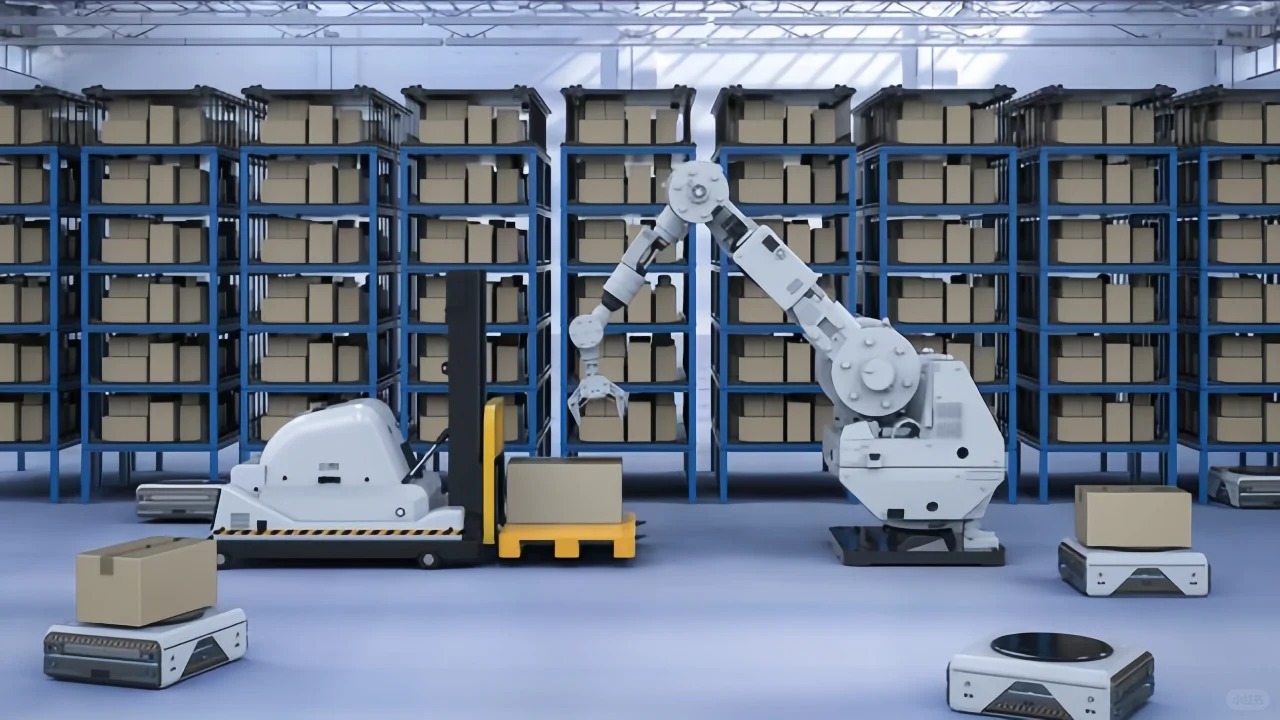
- Robotics and Automation : AGV penetration reaches 29%, sorting robots achieve a 99.9% accuracy rate, and冷链 AGVs can operate reliably in -25°C environments, while explosion-proof AGVs meet the safety requirements of the chemical industry.
- Software System Evolution : The WMS (Warehouse Management System) has evolved from a mere inventory-tracking tool into an intelligent decision-making hub, integrating AI-driven forecasting, digital twin technology, and real-time optimization capabilities. For instance, JD.com’s WMS system leverages machine learning to predict order fluctuations, enabling proactive adjustments in resource allocation and boosting peak-period processing capacity by 25%.
3. Policy Support and Industry Integration
- Policy dividends unleashed :
- At the national level, the "14th Five-Year Plan for Modern Logistics Development" calls for smart warehousing systems to achieve a penetration rate of over 50% by 2025. Meanwhile, the "Three-Year Action Plan for Digital Commerce" offers subsidies covering 30% of equipment investments and provides VAT exemptions. Local policies, such as Shanghai's plan to increase the proportion of high-standard warehouses to more than 40% by 2027, and Henan Province's initiative to provide up to 5 million yuan in subsidies for intelligent projects, further underscore the commitment to advancing logistics modernization.
- Green transformation orientation: Mandating the replacement of traditional energy equipment with new energy systems, reducing cold-chain warehouse product damage rates to 1.2%, and driving energy conservation and consumption reduction.
- Industry consolidation accelerates : Leading companies are strengthening their technological gaps through mergers and acquisitions—for instance, Donghu High-Tech acquired Prolog for 700 million yuan. As a result, the CR10 market share has risen from 14% in 2023 to 18% in 2025, with technological barriers and economies of scale gradually becoming more pronounced.
IV. Expansion of Application Scenarios and Case Validation
- E-commerce Industry JD.com’s “Asia No.1” unmanned warehouse processes millions of orders daily, boosting sorting efficiency by 40% while cutting labor costs by 70%. Meanwhile, Cainiao Network’s “Smart Pallet System,” with its modular design, enables rapid adjustments to warehouse layouts, increasing order-processing efficiency by 50%.
- Manufacturing Ningde Times' intelligent automated warehouse utilizes four-way shuttle technology, featuring 38,000 storage locations and boosting operational efficiency by 10 times. Meanwhile, automotive manufacturers integrate their Warehouse Management System (WMS) with the Manufacturing Execution System (MES), enabling real-time monitoring of component inventories and ensuring precise supply management.
- Pharmaceutical Industry : The intelligent warehouse system ensures precise control over drug expiration dates and storage conditions, meeting GSP certification requirements, while maintaining a temperature and humidity monitoring accuracy rate in cold-chain warehouses below 0.1%.
- New Energy Industry Companies like BYD are adopting intelligent warehousing systems to manage battery modules, achieving "zero-error" storage and driving an 80% year-on-year revenue growth for individual projects.
V. Challenges and Response Strategies
- Main Challenges : High initial investment (over 5 million yuan per system), significant challenges in technology integration, data security risks, and a shortage of talent (especially in-demand, multi-skilled professionals).
- Response Strategy :
- Technology-driven cost reduction : Modular design and remote operations & maintenance help reduce operational costs (AGV prices have dropped by 40% compared to 2020), while leading companies achieve rapid deployment through standardized modules (with a single-module deployment cycle of less than 45 days).
- Differentiated Competition Focus on niche areas (such as new energy and pharmaceuticals) to build technological barriers and avoid homogeneous price wars.
- Cash Flow Management Maintain a gross profit margin of over 20%, achieve an accounts receivable turnover rate exceeding 4 times per year, and ensure R&D investment accounts for more than 10%.
6. Future Trends and Identifying Breakout Points
- Short-term breakout point In 2025–2026, the AGV/AMR market is expected to reach 162.1 billion yuan, with a compound annual growth rate of 33.1%; meanwhile, the penetration rate of digital twin technology in the warehousing sector will rise to 45%, driving "unmanned warehouses" to become the mainstream model.
- Long-term value Intelligent warehousing will be deeply integrated into the digitalization of the supply chain, leveraging AI-driven decision-making, green energy, and flexible design solutions—such as modular warehousing—to transition from "scale expansion" to "value enhancement." This transformation will position intelligent warehousing as a core strategy for businesses aiming to reduce costs, boost efficiency, and achieve sustainable growth.
Driven by the confluence of market demand, technological breakthroughs, policy support, and industry application cases, smart warehousing is now poised for explosive growth. Although it faces initial challenges such as high upfront investments and complex technology integration, innovative advancements, strategic policy guidance, and industry-wide consolidation will likely pave the way for smart warehousing to achieve large-scale adoption between 2025 and 2026. This transformation is set to become a pivotal engine driving the logistics sector's upgrade and modernization, while also spurring broader ripple effects across downstream industries like manufacturing, new energy, and pharmaceuticals—ultimately fostering a trillion-dollar market ecosystem.
Hot Products
Related Articles
Get a free quote
We welcome any inquiry you may have. Tell us about your project to get a free quote.
National Service Hotline
Contact Email
Foshan City, Nanhai District, Shishan Town, Guanyao Ligang Zixia Industrial Zone
Scan to view the website