
GUANGDONG XIEDA INTELLIGENT EQUIPMENT CO., LTD.
Professional manufacturer of storage space

News
News
[Hi-Tech Intelligence] What Are the Main Components of a Stereoscopic Warehouse?
Keywords:
Publish Time:
2025-09-25
As industry 4.0 Deep integration with intelligent logistics, automated three-dimensional warehouses (automated stereoscopic warehouses, AS/RS ) Has already departed from “ Space Storage Tool ” Upgrade to “ Supply Chain Efficiency Hub ” Its core advantage stems from the synergistic operation of its constituent components, encompassing “ Physical storage - Automated execution - Intelligent Control Management - Auxiliary Support ” Four key dimensions. This article systematically dissects the core components of a stereoscopic warehouse, integrating technical parameters with real-world application cases to reveal the functional roles and collaborative logic of each part.
I. Core Storage System: The Automated Warehouse “ Physical skeleton ”
The storage system is the foundational carrier of the automated warehouse, serving as the core function for both load-bearing and space utilization. It primarily consists of Three-dimensional shelving And the accompanying storage unit configuration, whose design directly determines the warehouse's storage density and operational efficiency.
1.1 Vertical racking: Classified by structural type “ Spatial Matrix ”
Vertical racking systems achieve space-efficient utilization through vertical extension, and are primarily categorized into the following types based on cargo characteristics and operational needs: 4 Classes, with significantly different storage densities and application scenarios depending on the type:
Shelf Type
|
Structural Features
|
Storage density (storage locations) / ㎡)
|
Applicable Cargo Types
|
Typical Application Cases
|
Beam-type three-dimensional racking
|
Laminated board + Beam assembly, with independent storage locations
|
35-50
|
Tray-type items, large finished products (such as home appliances)
|
JD Asia No.1 Home Appliance Warehouse
|
Shuttle-type three-dimensional racking
|
Shuttle Car + Orbit, dense storage
|
60-80
|
Single-type, bulk cargo (such as food)
|
A fast-moving consumer goods company's ambient-temperature finished goods warehouse
|
Stacker-type three-dimensional racking system
|
Adapted for stacker access, with heights reaching up to 40 Rice
|
45-65
|
Multi-category, medium-to-high frequency turnover goods
|
Haier Qingdao Smart Manufacturing Parts Warehouse
|
Gravity-type three-dimensional racking
|
Inclined Track + Roller, goods slide by themselves
|
30-45
|
First-In, First-Out ( FIFO ) Goods (such as chemicals)
|
A raw material warehouse of a chemical enterprise
|
Data source: China Federation of Logistics & Purchasing CFLP )《 2024 "Annual Report on the Development of the Automated Stereoscopic Warehouse Industry"
1.2 Cargo unit: Standardized “ Minimum unit of storage ”
The cargo unit serves as the interface between the shelving and the goods, and is primarily categorized into Tray Unit With Material bin unit Two categories:
- Pallet unit: Designed to accommodate bulky, heavy-duty cargo (single-pallet load 500–3000 kg ), common specifications are 1200mm × 1000mm (National Standard), accounting for the total number of storage locations in the automated warehouse 78% (Data source: MHI "Global Material Handling Equipment Report" 2025 》);
- Material box unit: Designed for small, lightweight items (single-box load 50–300 kg ), often made from plastic or metal, and used in conjunction with mini stackers, accounting for over a significant share in electronic components and pharmaceutical warehousing. 60%。

(Shelf Storage Location)
II. Automated Handling Equipment: For the Automated Warehouse “ Execute hands and feet ”
Automated work equipment is the key to achieving “ Unmanned Access ” At its core, it replaces traditional manual forklifts, sorting processes, and other manual tasks, primarily including stackers. AGV/RGV , automated sorting equipment falls into three major categories, and its technical parameters directly affect warehouse operational efficiency.
2.1 Stacker crane: “ Vertical + Horizontal ” Dual-Dimensional Access Core
The stacker crane is part of the automated warehouse. “ Core handling equipment ” , responsible for the transfer of goods between shelf locations and inbound/outbound storage platforms, which can be structurally categorized into two types: aisle-type and bridge-type, with aisle-type accounting for the majority of the market. 92% ( CFLP Data):
- Aisle-type Stacker : Operates along shelf aisles, consisting of upright columns, cargo platforms, and a traveling mechanism. Key parameters are as follows:
- Running speed: 120-240m/min (High-speed models can reach 300m/min );
- Lifting and lowering speed: 20-60m/min;
- Positioning accuracy: ±3mm (Laser positioning) meets the demand for high-precision access;
- Case: A certain automotive parts warehouse uses a double-column aisle stacker crane, with each unit capable of completing per hour 80 Next access operation, significantly improved over manual forklifts 4 Twice.
- Running speed: 120-240m/min (High-speed models can reach 300m/min );
- Bridge-type Stacker : Cross-aisle operation, suitable for small spans ( ≤15m ), low altitude ( ≤12m ) Warehouses offer high flexibility but are relatively slower, making them more suitable for small to medium-sized automated warehouses.
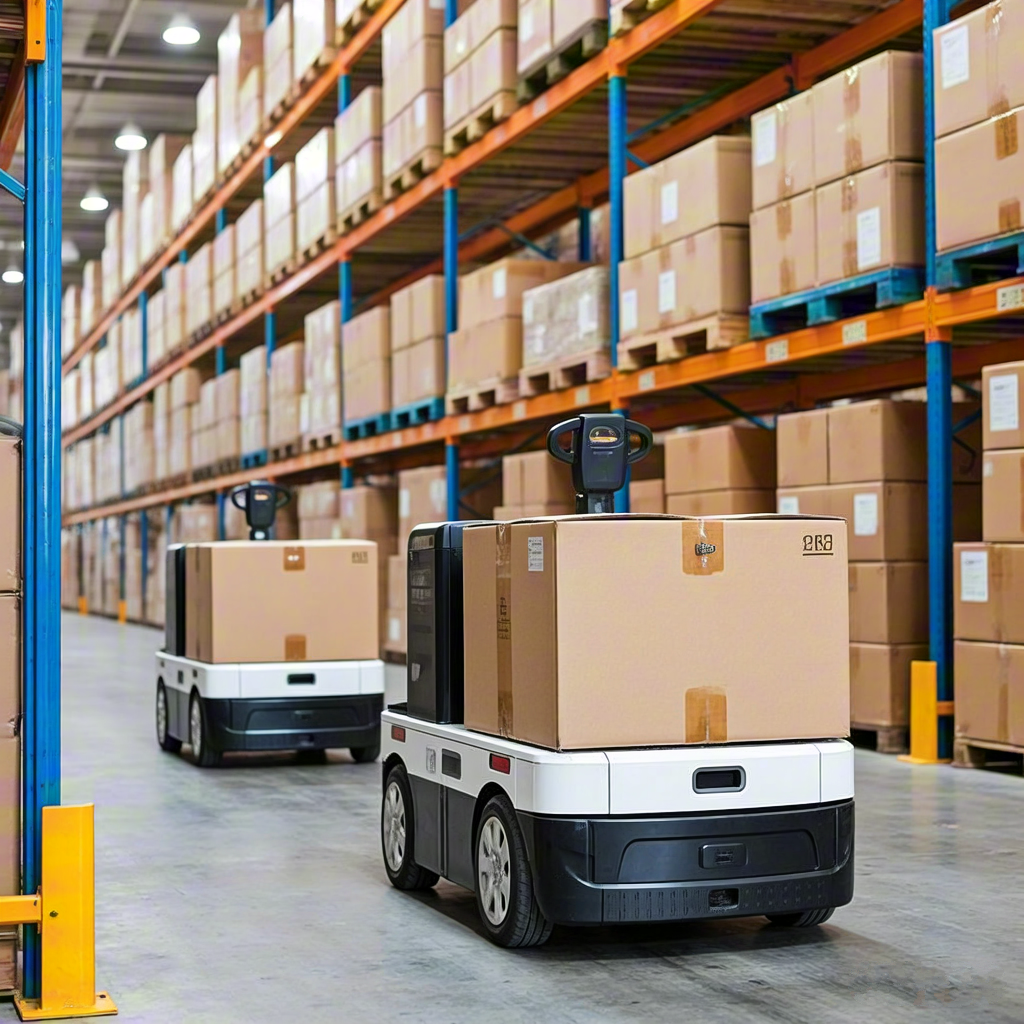
(AGV Equipment)
2.2 AGV/RGV : “ Shuttle within the venue ” The automated handling link
AGV (Autonomous Guided Vehicle) and RGV (The Automated Guided Vehicle) is responsible for operations within the warehouse “ Non-alleyway area ” The cargo transfer connects stackers, inbound/outbound docks, production workshops, and other key nodes:
- AGV : Trackless flexible operation, guided by laser and QR codes, with load-carrying capacity 500–5000 kg , widely used in e-commerce and pharmaceutical warehouses, a certain e-commerce company has deployed a three-dimensional warehouse 50 Taiwan AGV , achieving “ Goods-to-person ” Sorting, boosting workforce efficiency 3 Twice;
- RGV : Traveling along a fixed orbit, with speeds reaching up to 180 m/min , Load capacity 1-10t , highly stable and widely used in automated three-dimensional warehouses for heavy manufacturing industries (such as automotive and machinery), working in synergy with stacker cranes to achieve “ Unmanned Material Handling ”。

(Automated Sorting Equipment)
2.3 Automated sorting equipment: “ Goods flow ” The Precise Distributor
Sorting equipment is responsible for categorizing inbound and outbound goods according to orders and destinations. Common types include:
- Cross-belt sorter: Sorting Efficiency 1500–3000 Case / Hours, accuracy rate 99.95% , suitable for small- to medium-sized goods (such as clothing, 3C Product);
- Slider-style sorting machine: Load capacity can reach up to 50kg , wear-resistant and suitable for bulky, heavy goods (such as home appliances and furniture);
- Data Support: China Chain Store Association CCFA ) Research shows that automated sorting-equipped automated warehouses reduce order processing cycles compared to traditional warehouses. 60% That's all.
III. Intelligent Control System: For the Automated Warehouse “ Brain center ”
The control system is for the automated warehouse. “ Decision-Making Core ” By leveraging the synergy between software and hardware, we achieve end-to-end intelligent automation for equipment scheduling, inventory management, and job monitoring—primarily through a three-tiered system that seamlessly integrates into “ Instruction - Execute - Feedback ” Closed loop.
3.1 Warehouse Management System WMS ): “ Top-level planning ” The core of management
WMS It is a stereoscopic warehouse. “ Data Management Center ” , responsible for order processing, inventory management, and work schedule planning; core functions include:
- Inventory Management: Real-time monitoring of storage location statuses, with support for batch management and expiration-date management (e.g., in the pharmaceutical industry). GSP Compliance), inventory accuracy can reach 99.9% ;
- Order Processing: Automatically break down orders, generate inbound and outbound tasks, and assign them to the corresponding equipment;
- Case: A certain pharmaceutical automated warehouse achieves WMS Achieve pharmaceuticals “ Batch number - Expiration Date - Cargo position ” Bind, fulfilling national needs GSP Certification requirements, enhanced outbound inspection efficiency 50%。
3.2 Warehouse Management System WCS ): “ Mid-level scheduling ” The execution bridge
WCS Is “ Equipment Dispatch Center ” , Connect WMS With the underlying device, responsible for transferring WMS The task of converting assignments into device-executable instructions includes the following core functions:
- Equipment Coordination: Scheduling the stacker crane, AGV • Sorting machines work in coordination to avoid equipment conflicts;
- Path Optimization: Real-Time Computation AGV • Optimizing the stacking machine's operational path to enhance work efficiency;
- Technical specifications: Mainstream WCS The system supports 100 Simultaneous scheduling of more than one device, with command response time ≤0.5 Seconds.
3.3 Programmable Logic Controller ( PLC ): “ Bottom-level execution ” The device interface
PLC Is “ Device Control Terminal ” , directly connecting the stacker crane, AGV Wait for the hardware equipment, which will WCS The instructions are translated into device actions (such as walking, lifting, and sorting), with core functions including:
- Real-time control: Receive sensor signals (such as position and speed) to adjust the equipment's operational status;
- Fault Diagnosis: Monitor equipment operating parameters, automatically trigger an alarm and shut down the system when abnormalities occur, thereby minimizing fault-related losses.
- Data source: According to the industrial automation industry report, equipped with PLC The failure rate of the automated warehouse equipment is lower compared to traditional manual control. 70%。
IV. Auxiliary Support System: The Automated Warehouse's “ Safety and Environmental Support ”
Although the auxiliary systems do not directly participate in cargo storage and handling, they provide essential support for the stable operation of the automated warehouse. These systems primarily include fire protection, lighting, surveillance, and ventilation—four key categories—and must comply with relevant national standards.
4.1 Fire protection system: “ Safety bottom line ” The key guarantee
Due to their great height and dense storage of goods, automated warehouses require dedicated fire protection systems:
- Automatic sprinkler fire suppression system: Utilizes early suppression and quick response ( ESFR ) Nozzle, with a coverage height of up to 12m;
- Gas fire suppression systems: Ideal for scenarios where water-based extinguishing is unsuitable (such as electronic components or pharmaceutical warehouses), commonly using heptafluoropropane, IG541 Gas;
- Standard requirement: Complies with the "Code for Fire Protection Design of Buildings" GB 50016-2014 ), the fire safety acceptance pass rate must 100%。
4.2 Environmental Control System: “ Product Quality ” Stable assurance
According to the characteristics of the goods, the environmental control system includes:
- Temperature Control: The cold-chain automated warehouse utilizes industrial air conditioning, ensuring precise temperature control. ±1℃ , meeting the storage needs for food and pharmaceuticals;
- Humidity Control: Warehouses in humid regions are equipped with dehumidifiers, maintaining humidity levels at 40%-60% , preventing goods from getting damp and moldy;
- Case: A certain food automated warehouse utilizes an automatic temperature and humidity monitoring system to achieve 24 Real-time adjustment by the hour, reducing the rate of cargo damage to 3% Drop to 0.5% 。
4.3 Monitoring and Security Systems: “ Full-process visibility ” Management Support
Including video surveillance, access control, and infrared alarm systems:
- Video surveillance: Covers shelf aisles and loading/unloading points, with support 720P High-definition video recording, storage duration ≥30 Heaven;
- Access control system: Utilizing facial recognition, IC Card authentication ensures that only authorized personnel gain access, safeguarding the security of goods.
- Data support: A survey by the China Federation of Logistics & Purchasing shows that automated warehouses equipped with comprehensive security systems have a cargo loss rate lower than 0.01% 。
Conclusion
The efficient operation of a stereoscopic warehouse is not the result of a single piece of equipment. “ Going it alone ” , but rather “ Storage System - Work equipment - Control System - Auxiliary facilities ” The synergistic collaboration of four key modules: the storage system provides the spatial foundation, automated equipment executes physical tasks, the control system issues intelligent commands, and auxiliary facilities ensure safety and stability. As for AI Algorithms (such as intelligent path planning), Internet of Things IoT ) With the integration of technology, future automated warehouses will move toward “ More flexible, smarter, and greener ” Upgrade further to become the core hub for digital transformation in the supply chain. For enterprises, clearly defining the functional roles and collaborative logic of each component is the critical prerequisite for planning and constructing a state-of-the-art warehouse system.
Hot Products
Related Articles
Get a free quote
We welcome any inquiry you may have. Tell us about your project to get a free quote.
National Service Hotline
Contact Email
Foshan City, Nanhai District, Shishan Town, Guanyao Ligang Zixia Industrial Zone
Scan to view the website