
GUANGDONG XIEDA INTELLIGENT EQUIPMENT CO., LTD.
Professional manufacturer of storage space

News
News
What are the characteristics of an intelligent logistics warehousing system?
Keywords:
Publish Time:
2025-08-05
Intelligent logistics warehousing systems are modern solutions integrating advanced technologies such as the Internet of Things, big data, artificial intelligence (AI), and automated equipment. Their core features are highlighted below:
✅ High degree of automation and unmanned operation
✔️ Automated sorting/handling equipment (such as AGVs, stacking cranes, and robotic arms) replaces manual labor in handling and transporting goods;
✔️ Unmanned warehouse models reduce reliance on manpower and lower error rates (e.g., JD.com's "Asia No. 1" warehouse);
✔️ 24/7 operation significantly improves efficiency.
📌 *Example*: Amazon uses a cluster of Kiva robots to double order fulfillment efficiency.
📊 Data-driven precision decision-making
🔹 Real-time inventory monitoring: RFID tags and sensors collect data across the entire chain, dynamically adjusting storage strategies;
🔹 Intelligent predictive analysis: Based on historical sales data, predict supply and demand fluctuations and optimize replenishment plans (avoiding overstocking or stockouts);
🔹 Path algorithm optimization: AI calculates the optimal picking route, shortening walking distance by over 30%.
⚙️ *Technical Support*: WMS (Warehouse Management System) + WCS (Warehouse Control System) integrated operation.
🔄 Flexible response and scalability
✨ Modular design supports quick adjustments to shelf layouts and the addition/removal of workstations, adapting to surges in SKUs or seasonal peaks;
✨ Adaptability to multiple scenarios—can handle standard pallet goods as well as non-standard items and hazardous materials requiring special management;
✨ Cloud deployment allows for unified cross-regional management of multiple warehouse resources.
💡 *Advantages over traditional warehouses*: Reduced renovation cycle by 50%, reduced expansion costs by 40%.
🔍 End-to-end visual tracking
👀 Digital twin technology creates a virtual warehouse mirror, mapping the physical world's status in real-time;
👀 The coordinates, temperature and humidity environment, and transit time points of each item are traceable;
👀 Automatic anomaly alarm mechanism (such as inventory expiration reminders and equipment malfunction warnings).
📱 *User-end value*: Customers can view logistics progress at any time, enhancing trust.
⚡️ High-density storage and maximized space utilization
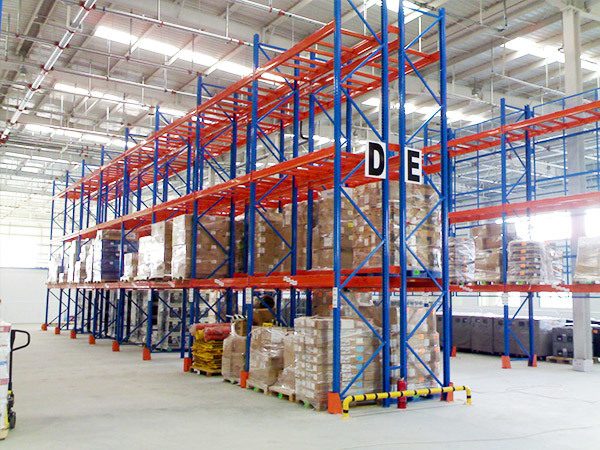
✅ Three-dimensional shelving systems extend upwards (up to 20 meters or more), increasing storage capacity by 3-5 times compared to flat warehouses;
✅ Swarm-like dense storage combined with dynamic zoning algorithms eliminates wasted space in fixed aisles;
✅ Cold and hot separation design caters to the quick in-and-out needs of high-frequency turnover goods.
🏗️ *Typical application*: Automated high-bay cold storage in the pharmaceutical industry with precise temperature control within ±1℃ error.
🤝 Deep integration of the supply chain ecosystem
🔗 Seamless integration with ERP/OMS systems, realizing end-to-end integration from procurement to production, warehousing, and distribution;
🔗 Supports third-party logistics platform interface embedding, promoting standardized collaboration between upstream and downstream;
🔗 Blockchain-based evidence ensures that transaction records cannot be tampered with, improving transparency in multi-party collaboration.
🌐 *Industry trend*: Gartner reports that 75% of companies will choose WMS based on open API capabilities.
🛡️ Enhanced security and fault tolerance mechanisms
🔒 Multiple protection systems include electronic fences, biometric access control, and fire linkage devices;
🔒 Dual-machine hot standby redundancy design ensures uninterrupted system operation;
🔒 AI risk control model identifies suspicious operations (such as monitoring illegal nighttime entry).
⚠️ *Necessity*: According to the National Bureau of Statistics, intelligent transformation has reduced warehouse accident rates by 82%.
♻️ Green and low-carbon operation mode
🌿 Energy-saving lighting/HVAC systems adaptively adjust energy consumption based on workload;
🌿 The reuse rate of recycled packaging materials exceeds 90%;
🌿 The proportion of new energy forklifts is increasing year by year, reducing carbon emissions by 60% compared to traditional warehouses.
🌱 *Policy guidance*: ESG rating has become one of the entry thresholds for suppliers of leading companies.
🚀 Continuously iterative learning system
Machine Learning continuously optimizes algorithm accuracy, for example:
• Self-updating sorting rules based on the characteristics of new product categories;
• Learning preventive maintenance strategies from historical failures;
• OCR recognition of handwritten documents breaks down language barriers.
📈 *Effect verification*: During a major e-commerce promotion, the order allocation accuracy after ML training reached 99.98%.
Summary: Core Value Dimension Table
| Dimension | Traditional Warehouse Pain Points | Intelligent System Breakthrough Points |
| Efficiency Bottleneck | Time-consuming manual goods retrieval | AMR robot millisecond-level positioning |
| Management Blind Spot | High probability of discrepancies between accounts and physical inventory | RFID real-time inventory with zero errors
| Lack of Flexibility | Risk of warehouse overflow during peak season | Cloud resource elastic scaling
| Decision Lag | Experience-driven, leading to backlog risks | Big data prediction and proactive intervention
| Energy Waste | Extensive temperature control/lighting | IoT-based refined energy management
The future direction of development is towards self-evolving cognitive warehouses, combining edge computing to achieve millisecond-level response decision-making and redefining the intelligent boundaries of logistics infrastructure.
Hot Products
Related Articles
Get a free quote
We welcome any inquiry you may have. Tell us about your project to get a free quote.
National Service Hotline
Contact Email
Foshan City, Nanhai District, Shishan Town, Guanyao Ligang Zixia Industrial Zone
Scan to view the website