
GUANGDONG XIEDA INTELLIGENT EQUIPMENT CO., LTD.
Professional manufacturer of storage space

News
News
Analysis of Warehouse Rack Types and Applications in the Automotive Manufacturing Industry
Keywords:
Publish Time:
2025-07-11
The warehousing rack models in the automotive manufacturing industry are diverse, designed to meet the storage needs of various types, sizes, and weights of automotive parts and finished products. The following are some common warehousing rack models and their applications in the automotive manufacturing industry:
I. Heavy-duty racking
Heavy-duty racking is widely used in the automotive manufacturing industry, mainly because the parts involved are usually heavy and numerous. Heavy-duty racking is suitable for almost all industries and warehouses; it has a strong load-bearing capacity, a stable structure, and can safely store heavy automotive parts. In addition, heavy-duty racking can be used with some functional accessories, such as mesh decks, steel decks, and back nets, to prevent small parts from falling during storage.
II. Mezzanine racking
Mezzanine racking is particularly common in the automotive parts manufacturing industry. Mezzanine racking makes full use of warehouse height, improving space utilization, and is especially suitable for storing goods with smaller quantities and volumes that are manually accessed. For the automotive manufacturing industry, mezzanine racking can be used to store various small parts and tools, thereby optimizing warehouse space and improving storage efficiency.
III. Flow racking
Flow racking, also known as gravity flow racking, is also often seen in the automotive manufacturing industry. It utilizes the self-weight of the goods to store from one aisle and retrieve from another, achieving a first-in, first-out system. Flow racking is highly efficient and suitable for the short-term storage and picking of large quantities of goods. In the automotive manufacturing industry, this racking model is often used to store parts that need frequent access on the assembly line to improve production efficiency.
IV. Automated high-bay warehouse racking
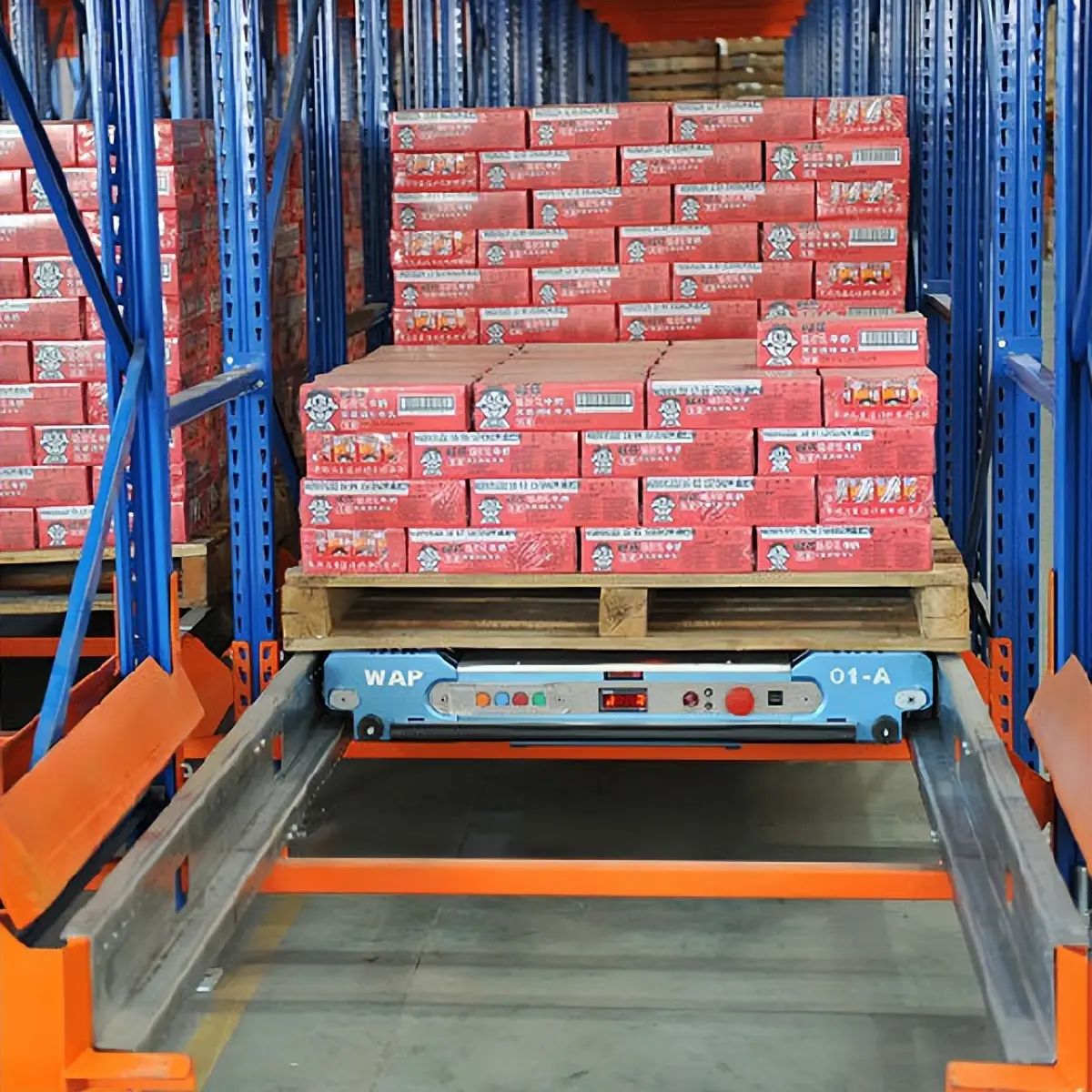
With the development of automation technology, the application of automated high-bay warehouse racking in the automotive manufacturing industry is becoming increasingly widespread. This racking model can achieve automatic retrieval, ensuring first-in, first-out, and facilitating goods picking. Automated high-bay warehouse racking is usually used in conjunction with stacking cranes, shuttle cars, and other equipment to achieve efficient storage and retrieval operations. Although the procurement cost is relatively high, the improvement in production efficiency and cost savings are significant.
V. Non-standard automotive parts turnover racks
In response to the irregularity and diversity of automotive parts, non-standard automotive parts turnover racks have emerged. These racks are usually custom-designed to meet the storage needs of parts of different sizes, shapes, and materials. Non-standard turnover racks not only have higher storage efficiency but also effectively protect parts from damage. In addition, they can be recycled, meeting environmental requirements.
VI. Other racking models
In addition to the common racking models mentioned above, the automotive manufacturing industry may also use other types of racks, such as mold racks, drive-in racking, cantilever racking, etc. These racking models have their own characteristics and are suitable for different storage needs. For example, mold racks are specifically used for storing large molds; drive-in racking is suitable for storing long and narrow goods; cantilever racking is suitable for storing heavy and irregularly shaped goods.
In summary, the warehousing rack models in the automotive manufacturing industry are diverse. Companies should select appropriate racking models based on their storage needs, goods characteristics, and warehouse conditions to improve storage efficiency, reduce costs, and optimize warehouse space utilization.
Hot Products
Related Articles
Get a free quote
We welcome any inquiry you may have. Tell us about your project to get a free quote.
National Service Hotline
Contact Email
Foshan City, Nanhai District, Shishan Town, Guanyao Ligang Zixia Industrial Zone
Scan to view the website